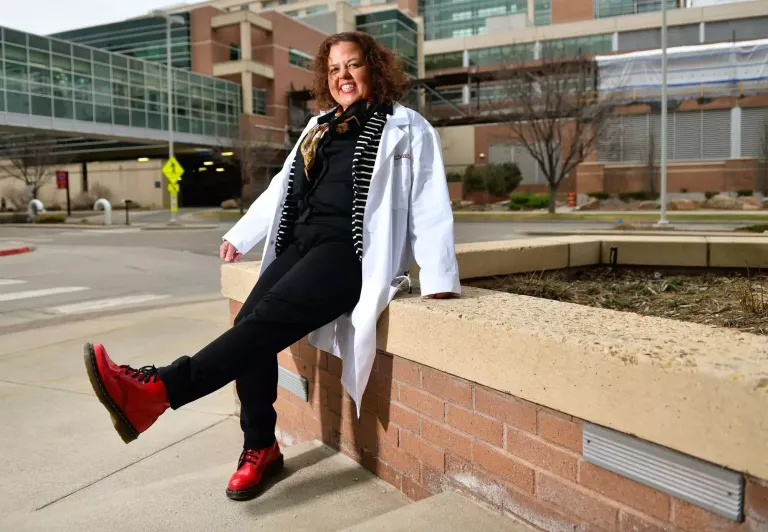
photo of uc health hospital

Forging a Future of Hope: The CU Anschutz and UCHealth Mental Health Partnership
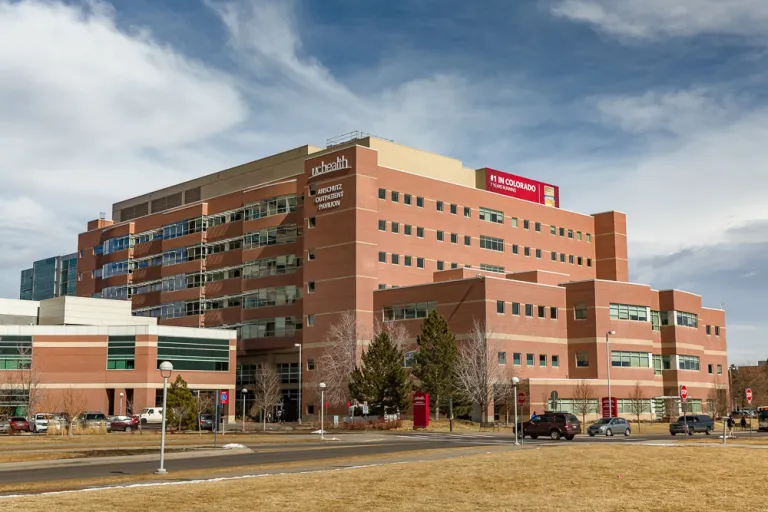
In the face of a nationwide mental health crisis, CU Anschutz and UCHealth have emerged as national leaders, not only in research and treatment but in forging innovative pathways to bring care to those who need it most. Their partnership is a testament to what’s possible when academic excellence meets clinical innovation—and when both are driven by a shared commitment to healing minds and saving lives.
At CU Anschutz, collaboration is more than a value—it’s a strategy. The response to the mental health crisis has been a campus-wide coalition of willingness, with support from the highest levels, including the Chancellor’s office and our clinical partners. This unified vision led to a transformative philanthropic investment to recruit Dr. C. Neil Epperson, a nationally renowned psychiatrist, as the Robert Freedman Endowed Professor and Chair of the Department of Psychiatry in the School of Medicine. UCHealth University of Colorado Hospital matched a portion of this commitment, underscoring the depth of their partnership.


Infographic illustrating how lives have been changed by the Department of Psychiatry
Lives changed by the Department of Psychiatry


Since Dr. Epperson’s arrival six years ago, the impact has been profound. The number of lives touched annually has grown significantly, thanks to expanded capacity and cutting-edge care. UCHealth’s new hospital tower now houses a 40-bed behavioral health wing, offering patients a healing environment grounded in the highest standards of care. Meanwhile, tele-mental health services have extended the reach of CU Anschutz’s expertise across Colorado, bringing care to rural and underserved communities.

This collaboration is already showing measurable results. Colorado, served by UCHealth, is currently the only state in the nation where suicide rates are trending downward—a powerful indicator of the effectiveness of integrated, accessible mental health care.

The partnership’s commitment to addiction science is equally strong. At the Center for Dependency, Addiction and Rehabilitation (CeDAR), a reset in leadership and vision is driving the development of new clinical care models. These models are designed not only for effective treatment but for long-term success after discharge, with a more intentional approach to patient admissions and care planning.

Infographic illustrating how UCHealth University of Colorado Hospital is expanding access to mental health care
Increasing patient access through UCHealth University of Colorado Hospital


UCHealth has invested over $150 million in the last five years to improve access to behavioral health care. This includes integrating mental health screenings into primary care visits, expanding virtual behavioral health services and increasing inpatient units — all aimed at removing barriers and creating a seamless continuum of care.

Together, CU Anschutz and UCHealth are proving that when research, philanthropy and clinical care align, transformation is possible. As the largest academic medical campus in the Rocky Mountain region, CU Anschutz has the ingredients to accelerate breakthroughs in mental health. And with UCHealth University of Colorado Hospital as our steadfast hospital partner, the vision of reaching people and families across the lifespan with compassionate, evidence-based care is not just a goal—it’s a reality.

Campus

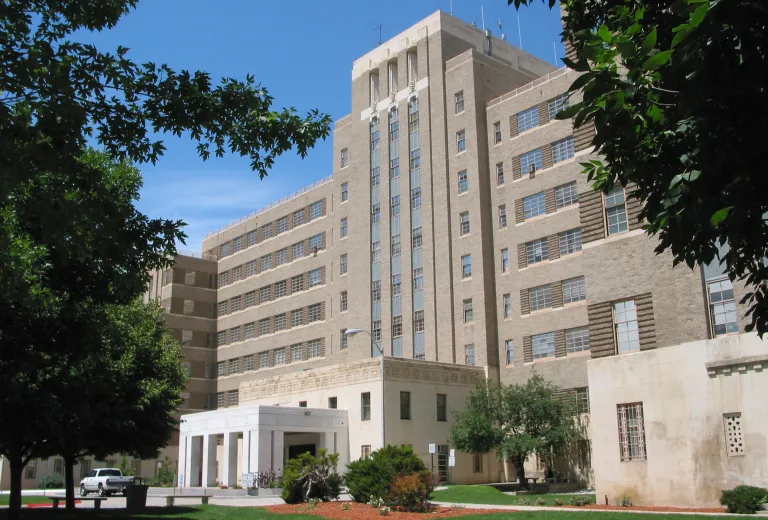
A photo of a tall gray stone building on the CU Anschutz campus

CU Anschutz: Advancing Colorado’s Mental Health Workforce

The University of Colorado Anschutz Medical Campus is at the forefront of developing a robust, diverse and highly skilled mental health workforce to meet the growing needs of communities across Colorado and beyond. Through innovative academic programs, clinical training and interdisciplinary collaboration, CU Anschutz is preparing professionals who are equipped to address mental health, substance use and wellbeing at individual and population levels. 


A National Leader in Population Mental Health 

CU Anschutz is home to one of the nation’s first accreditedMaster of Public Health (MPH) programs in Population Mental Health & Wellbeing. Offered online and on campus, this program provides students with a strong foundation in public health principles, while specializing in mental health, substance use and wellness. Students gain access to faculty experts in areas such as autism spectrum disorders, cannabis use and suicide prevention, and join a community committed to reducing the burden of mental health challenges on individuals, families and communities. 


Training Mental Health Nurse Practitioners 

TheCU College of Nursingoffers Nurse Practitioner programs focused on mental health, preparing advanced practice nurses to assess, diagnose and treat patients of all ages with mental health concerns. These professionals play a critical role in expanding access to care, particularly in underserved and rural areas, and are trained to provide a holistic approach to care, using a combination of medication, therapy and health promotion techniques to meet patients where they are. 


Expanding Rural Access Through the School of Medicine 

TheUniversity of Colorado School of Medicine’s Rural Programbuilds on the success of its original Rural Track, which was founded in 2005 as an elective for medical students interested in rural practice. Under the leadership ofDr. Mark Deutchman, the program aims to increase the number of CU medical school graduates who enter and remain in practice in rural Colorado. 

Students in the Rural Program gain a robust clinical experience designed to prepare them for the unique challenges and rewards of rural medicine. From the plains to the mountains, Colorado offers diverse opportunities for students to live, train and serve. Participants benefit from a strong support network of like-minded peers and faculty, and graduate with the skills and confidence needed to provide high-quality care in underserved communities—where their expertise is truly needed and deeply appreciated. 


Interdisciplinary Training Across PA, PT, and MD Programs 

The University of Colorado School of Medicine integrates mental health training across itsPhysician Assistant (PA), Physical Therapy (PT) and Medical Doctor (MD)programs. These future providers are equipped with the knowledge and skills to recognize and address mental health concerns as part of holistic patient care, strengthening the behavioral health capacity of the broader healthcare workforce. 


Department of Psychiatry: A Hub for Workforce Development 

TheDepartment of Psychiatryat CU Anschutz offers a wide range of workforce development initiatives, including: 

These programs provide rigorous clinical training and mentorship, preparing professionals to deliver specialized care in high-demand areas such as child and adolescent psychiatry, trauma and substance use. 


The Role of Philanthropy 

Donor support is essential to expanding these workforce development efforts. Philanthropic investment helps CU Anschutz: 

  • Recruit and retain students from underrepresented backgrounds
  • Provide scholarships and financial supportfor tuition, fees and living expenses
  • Fund clinical training opportunitiesin underserved communities
  • Support faculty innovation and researchin mental health education
  • Expand access to carethrough community-based partnerships and outreach 

By investing in CU Anschutz’s mental health workforce initiatives, donors play a vital role in shaping a future where mental health care is accessible, equitable and effective for all. 


Campus

Dreaming of America in Liberia

Salwa Bamba provides a first-person account of how the generosity of others propelled her success.

My name is Salwa Rita Mourtada Bamba. I am originally from Liberia in West Africa, and I came to the United States seeking asylum when I was 20 years old.

Before the civil war, life in Liberia was everything a kid would hope for. I had two brothers and my older sister. We grew up together on a huge property where my father had a couple of stores and a restaurant. There were gazebos and tables all over the compound, a basketball court, volleyball court, and a playground with swings, merry-go-round, seesaw, monkey bars. It was a kid’s dream.

But when the war started in 1989, everything changed.

I was 12 when the country started to get tense. We could tell something was wrong, and we would see footage on TV of the massacres. We watched the rebels advance toward the capital and as they approached our area, we saw the fires, the looting, the rape. My father was captured and we didn’t see him for a long time. It was just me, my siblings and my mom in a camp. Everything was destroyed. We were sleeping on the floor. We had nothing.

Salwa Bamba with siblings in Liberia

We were reunited with my father in 1991, but not long after that, my sister Laila Annette was captured and murdered. Believe it or not, our family never sat down to talk about her death. I don’t think any of us have the courage to reminisce about her life because we’re afraid to break down. She had so many dreams. She would say, “I want to be an artist. I want to be a surgeon. I want to be a firefighter.”

After Laila’s death, my parents sent me to Ghana to stay with an acquaintance from church, who provided a place to live, but no other support. It was so difficult not having parents with me as a 14-year-old. When I got sick with typhoid fever, I had no one to take care of me. I would go to the hospital and there was no one to pay the bill.

Salwa Bamba as a teenager, she is smiling and wearing a white dress with pink, green and yellow geometric designs.

After I graduated from high school in Ghana, I started to dream about studying medicine in the United States. I had become interested in medicine during a period of relative peace in Liberia, when I helped United Nations doctors care for the sick and injured as a 13-year-old triage nurse. It brought me so much fulfillment to watch people get better. And I had always dreamed about America. In Liberia, all of our school books were from America, so I knew about Pecos Bill and tornados. At my dad’s restaurant, I would change my accent to speak like an American.

My dad had connections, so when I told him about my dream of studying in the United States, he talked to the American ambassador for me. Eventually, when I was 20, I came to New York City by myself. Reality hit me when I arrived at my aunt’s place in Queens and I saw that she had six children in a two-bedroom apartment. I started missing my nice beach back home.

After a year in New York City, I moved to Colorado, where my uncle lived, and I started pursuing a bachelor’s degree in nursing at CU Denver. Because of my temporary protected status, I was never eligible for federal or state aid, which meant I had to work for one semester to save up money, go to class for a semester, and then stop to save up money again. To add to the challenge, my temporary protected status would expire every 18 months, along with my driver’s license and my ability to work. That’s when I really had to hustle.

Later, when I had children, we relied on food stamps and food pantries. At one point, I was homeless and slept in my car with my son. Before one particular semester, I begged the bursar to let me register even though I didn’t have the money to cover the fees. He suggested I apply for scholarships. I said, “I don’t have a green card. I’m not eligible.” He replied, “You might find one or two that don’t have those requirements.” So, I looked and finally found one for $2,500. I applied, and lo and behold, I got it. From then on, I would always enter to win some award, and I would receive $1,500 here and there.

I also got help from people who knew what I was made of. My pastor loaned me $3,000 to pay for my first semester at CU. My brother loaned me a few hundred dollars here and there. When my dad was alive, he would send me money. And a few years ago, my mom loaned me $5,000 to pay for a semester of my master’s program. People have stood by me and pushed me. I stand on their shoulders today and I am proud.

Salwa with work colleagues at her clinic

My life changed when I graduated with my bachelor’s degree and got my nursing license. I moved out of my little condo where the landlord was after me every week and rented a beautiful apartment. Fifteen years after I arrived in America, I finally found my feet.

While I was working on my bachelor’s degree, I was always driving up and down Colfax Avenue. I watched the Fitzsimons campus being transformed into the Anschutz Medical Campus and I said to myself, “I will graduate from here one day.”

True to my word, I did graduate from the University of Colorado College of Nursing in 2020, and I currently work there as an assistant professor and at the CU Family Health Clinic as a nurse practitioner. I love my job. When I learn that a patient has done something I told them to do, I yell, “Oh my god!” and everyone comes running, thinking something’s wrong. But I’m just celebrating that my patient is doing OK. The saying is true: Do what you love and you’ll never work a day in your life.

The benevolence of others has been crucial to the story of my success. I cannot overemphasize how their willingness to help and be of service has impacted my life and my children. My daughter and son are both scholarship recipients at CU Boulder, and my son is about to complete his engineering degree with scholarship support from the Engineering GoldShirt Program.

Sometimes I wish my journey would not have been so rough. But despite everything, I am blessed. Everything that happened along the way has prepared me for what I will be called to do tomorrow.

Salwa Bamba with family. They are wearing white shirts and blue jeans.

With scholarship support, Salwa Bamba graduated with three degrees from CU: a bachelor’s degree in nursing in 2011, a master’s degree in nursing in May 2020, and doctor of nursing practice degree in 2021. She joined the first nurse practitioner fellowship in geriatric medicine at the UCHealth Senior’s Clinic, and she serves as a board member of the CU College of Nursing Alumni Association and the Community College of Denver Business Administration Advisory Board.

Bamba is currently a clinical faculty member at the CU College of Nursing’s Belleview Point Clinic, a facility for patients from marginalized backgrounds. She also mentors high school students through Denver Public Schools and has worked with the Cherry Creek School District to host immunization drives for low-income students and families. As a student at the CU College of Nursing, Bamba and a group of classmates started Future Voices, an organization striving to amplify the voices of underrepresented nursing students. The group currently runs a mentorship program with Hinckley High School, hosts donation drives for books and scrubs, and fundraises to help nursing students pay for school. Bamba also runs the Laila A. Mourtada Foundation; named after Bamba’s sister, the foundation focuses on education and health literacy for women and girls in Liberia.

Why not be fearless when fighting a global pandemic?

Why not be fearless when fighting a global pandemic?

CU Anschutz's Dr. Michelle Barron battles the COVID-19 pandemic on the front lines and keeps smiling despite the challenges.
Why not be fearless when fighting a global pandemic?

Why not be fearless when fighting a global pandemic?

CU Anschutz's Dr. Michelle Barron battles the COVID-19 pandemic on the front lines and keeps smiling despite the challenges.
Content Section

Dr. Michelle Barron has had a tough three years. When the COVID-19 pandemic was declared a national emergency in the U.S. in March 2020, her job put her on the front lines.  

But Barron, the senior medical director of infection prevention and control for UCHealth University of Colorado Hospital, and her team were up for the challenge, drawing on years of experience researching infectious diseases to improve public health outcomes.

Our team approaches every day asking ourselves, ‘Why not aim for zero preventable infections?’ Then we build systems and operations to make that a reality.
-- Dr. Michelle Barron

“Fear of the unknown doesn’t scare me at all because this is what I do. I’m an infectious disease doctor and I do detective work,” Barron says. “I often start with unknowns and that's what drives me to try and figure out what is wrong.”


Responding to the Unknown Without Fear

As an expert on infectious diseases, Barron’s job involves planning for pandemics before they happen.

“People don’t think about this, but pandemics occur about every 10 years. They’re not all of the same magnitude, but if you’re in my world, you prepare,” Barron says. “You think through what resources you need for patients and for staff.”

So, when COVID-19 hit in March 2020, Barron and her staff were able to take a systematic approach to understanding the pandemic even though there were so many unknowns.

“We were dealing with a new disease. In addition to a lack of information, there was also an unbelievable amount of erroneous information. The evidence wasn’t as firm as we were used to, everything was changing quickly,” she says. “It was like working in a hurricane.”


Dr. Michelle Barron at UCHealth University of Colorado Hospita

Dr. Michelle Barron at UCHealth University of Colorado Hospital.


To develop an effective pandemic response, Barron and her team drew on existing models from the 1918 flu pandemic and other pandemics to predict disease spread, to plan for staffing shortages and hospital triage measures and to determine how to prevent transmission.

“While I can appreciate that some things are not preventable, our team approaches every day asking ourselves, ‘Why not aim for zero preventable infections?’” Barron says. “Then we build systems and operations to make that a reality.”

With these models, they were able to plan for hospital staff and their family members getting sick which enabled them to backfill positions and plan for staff to miss work due to their children’s school closures.


Inspiring Patients and Donors

Barron's can-do attitude has drawn attention from donors over the years.  

After a rare bacterial infection landed George Sissel in the hospital in 2019, he and his wife Mary Sissel were so impressed by Barron’s approach to diagnosis that they decided to support her research.  

Barron says their generous offer came at a particularly crucial time for her.

“I had been wanting to look at how many people get fungal infections,” she recalls. “It’s an important area of study but it’s not something you get federal grants for. When I met the Sissels, I had just been getting to the point where I was about to say I’m not doing research anymore.”

With help from the Sissel family, Barron’s research got back on track. Barron has since partnered with her colleague, Dr. Esther Benamu, to complete a study on fungal infections in patients with underlying blood cancers or transplants. Barron is also investigating the links between COVID-19 and fungal infections.


Working with Communities

In addition to providing patient care, conducting research and steering the hospital through its pandemic response, Barron also partners with churches, community centers and other local organizations on community outreach. Barron’s team leverages the organizations’ community connections to reach the largest number of people.

“Often, the natural cultural navigators will be community members with a bit of health care training that people seek out when they need something,” she says. “Once you find them, you sit down with them and get them on board. That’s how you reach the rest of the community.”  

Barron also made it a priority to support public COVID-19 vaccination drives throughout Colorado. At one vaccine drive held next to a Broncos training camp, Barron spoke with local news reporters who were on site to cover the training camp.

“People actually showed up and said, ‘We saw you on the news just now and thought, well, why not?’” Barron recalls. “That was one of my heart-melting moments where I was so happy I do this work. If I can convince one person to get a vaccine, I’ve made a difference in the world and that matters to me.”


Barron (in background) oversees vaccination event for the Denver

Barron (in background) oversees vaccination event for the Denver

Although Barron says she was never afraid during the pandemic, her anxiety level would rise and fall based on what was happening. She struggled with “turning off” after long and stressful days, but personal support from friends like the Sissels sustained her through the toughest times. “Like many of my friends did throughout the pandemic, Mary and George would text me if they saw me on the news or on a campus presentation to wish me well,” Barron says. “Their philanthropy is an example of how they watched and cared for me, but they also did this in a very personal way.”

Campus