KPWE Banner Alt Text


Tiffany Sinclair’s journey took some unexpected turns.

She endured the sudden death of her husband from toxic shock syndrome, the diagnosis of her 11-year-old daughter with brain cancer, then the death of her mother from liver cancer.

So when Tiffany was notified several years back that the University of Colorado Colorado Springs had accepted her as a Karen Possehl Women’s Endowment (KPWE) scholar, she remembered being shocked.

“I thought, ‘Wow. Somebody heard my story,’” she said. “It was really the inspiration for me to keep going.”
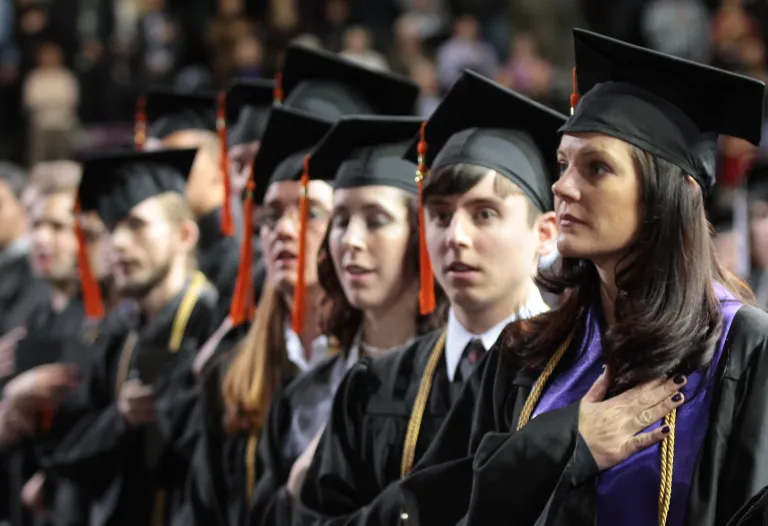
Which she did, all the way to the master’s in counseling and human services she earned in 2015.

Each year at UCCS’ KPWE Unstoppable Women’s Luncheon, more than 400 people gather to hear stories like Tiffany’s, shed tears of joy and share looks of amazement.

Then, they make gifts to support more UCCS scholars who have overcome formidable personal obstacles to their college education.

Just a few of the challenges KPWE scholars have overcome include spousal abuse, substance addiction and family health crises.

Such challenges are extreme even compared with other nontraditional UCCS students—and nationally, only about one in three “typical” nontraditional students graduate. But with the program’s tuition support (more than $350,000 in 20 years), personal mentorship, and childcare support, KPWE scholars have a 93 percent graduation rate.

The Unstoppable Women’s Luncheon is annually a red-letter date not only for UCCS, but also for Colorado Springs civic and community leaders who often double as KPWE mentors. One such leader is local arts luminary Mary Mashburn.

“Every year, I wear the same jacket to this event, and I contribute what I don’t spend on a new jacket for this event as a donation to KPWE,” Mary told the crowd in 2015, her ninth year at the luncheon.

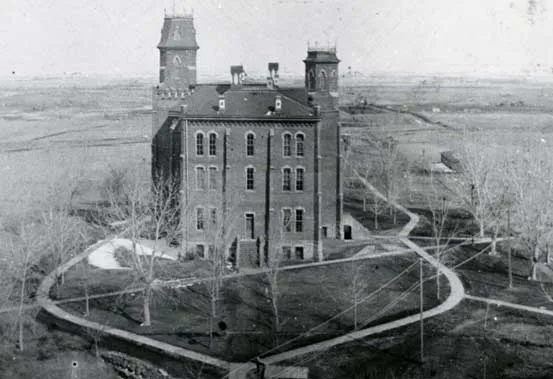
Old Main Building

Before there was CU, a courageous and tenacious few were so profoundly committed to the transformative power of an education.

The idea of a public university in the young Colorado territory was considered a valuable and worthwhile pursuit as early as 1861. But political disputes, economic distress and local jealousies stalled the idea from becoming a reality for years. Some folks clamored that Colorado didn’t have any use for an academic institution.

But some early settlers never gave up.

First, there was the gift of land. Three Boulder families—Marinus and Annie Smith, George and Mary Andrews, and Anthony and Mary Arnett—collectively donated 51 acres of land on the heights south of Boulder Creek, which was formally accepted in January 1872 by the legislature as the permanent location of the future university.

Funds were still needed for a university building. Bitter rivalries among Colorado’s lawmakers, who wanted their communities selected instead as the home for a public university, continued to embroil the idea for another two years. Then, in January 1874, the Colorado Territorial Legislature agreed to provide $15,000, a sizeable sum in those days, toward a university on the condition Boulder citizens contribute an equal amount.

David Nichols, the territory’s speaker of the house and a Boulder resident, realized he needed to immediately raise the necessary funds, lest his town lose the opportunity.

Legend has it, Nichols said: “If $15,000 is what they want, we’ll get it.”  

Like Paul Revere, he rode by horseback that cold and rainy January night for five hours the 30 miles between Denver to Boulder to knock on the doors of ordinary citizens to see if they could—if they would—donate the money.

The fate of CU hung in the balance.

By the time a weary Nichols was back at his legislative seat in Denver the next morning, Boulder residents—104 parties, to be exact—had pledged the funds needed to secure the University of Colorado, and the appropriation bill passed.

Collectively, the citizens of Boulder committed a total of $16,806.66—more than enough to give the fledgling university a permanent home. Pledges ranged from $15 to $1,000. More than half the donors contributed fewer than $100. Finally, after long years of struggle, the University of Colorado was more than an idea—it had sufficient funds to begin the construction of the first university building.

On Sept. 20, 1875, the cornerstone for Old Main was laid. By the following spring, CU officially opened its doors, five months before the Centennial State joined the union in 1876.

After 15 years of effort, and though these early philanthropic contributions placed a true hardship on Boulder’s frontier families, their commitment to education remains an enduring testament to what CU stands for to this day.

It is a legacy upon which we continue to build and honor.

chris and brad cillian
Content Section

In 2006, Christine Cillian’s life changed forever. She wouldn’t know how severely for another two years.

Christine, then 29, suffered a severe neurological attack that she had thought pointed to multiple sclerosis. Her arms fell limp. She couldn’t walk. Her body failed to function.    

“Everything turned upside down,” she says.

Doctors at the time said she didn’t have MS. But she learned in January 2008 they were wrong: An MRI revealed brain lesions and definitively diagnosed Christine with the disease.

Over several months, she grappled with anxiety, fatigue and depression—the “silent symptoms,” her husband, Brad, calls them.

They immediately turned to the Rocky Mountain Multiple Sclerosis Center at University of Colorado, where national-caliber research and treatment is paired with compassionate support and education. There, they started an “MS 101” class, sought a second opinion and soon began aggressive care.

Dr. Timothy Vollmer, a center co-director, told Christine that without intensive treatment, she faced severe disability. So Christine participated in clinical trials and took a drug developed for cancer but effective in treating MS. And she confronted her disease comprehensively with exercise, counseling, education and medicine.

“That’s how I want to treat my disease—aggressively,” Christine says.

Now life—upside down to this point—has began to right itself. The possibility of a brighter future seems within Christine’s reach.

As it’s done for many patients, the MS Center is slowing the disease and its effects with the patient-centered care it’s practiced for more than 30 years.

Brad says it’s revolutionizing future care within Colorado and across the nation.

“We’re lucky to have it in our backyard,” he says, adding that the center’s doctors hold weekend seminars around the country, so more than just Front Range patients benefit from the center’s expertise. “Everybody gets access to best-in-the-country care.”

That top-notch treatment happens, the Cillians note, partly because gifts support the center. Donor generosity enables staff to work toward earlier diagnoses, individualized care and research that identifies steps toward, perhaps, a cure.

MS changed everything for the Cillians. But the MS Center is changing everything again—her health, their marriage, their perspective—for the better.

In gratitude, the Cillians donate to the center, and Brad serves on its board.

“We’ve gotten so much out of the center that the bare minimum we can do is give back so that others can have that access,” he says.

That is access, Christine says, to more than innovative treatment; it’s a partnership with people who care deeply for their patients.

“It's not just a job for them,” she says. “These people are truly passionate about doing something about MS.”

Campus
tanddean rustandy class
Content Section

Thursday, Friday, Saturday, Sunday.

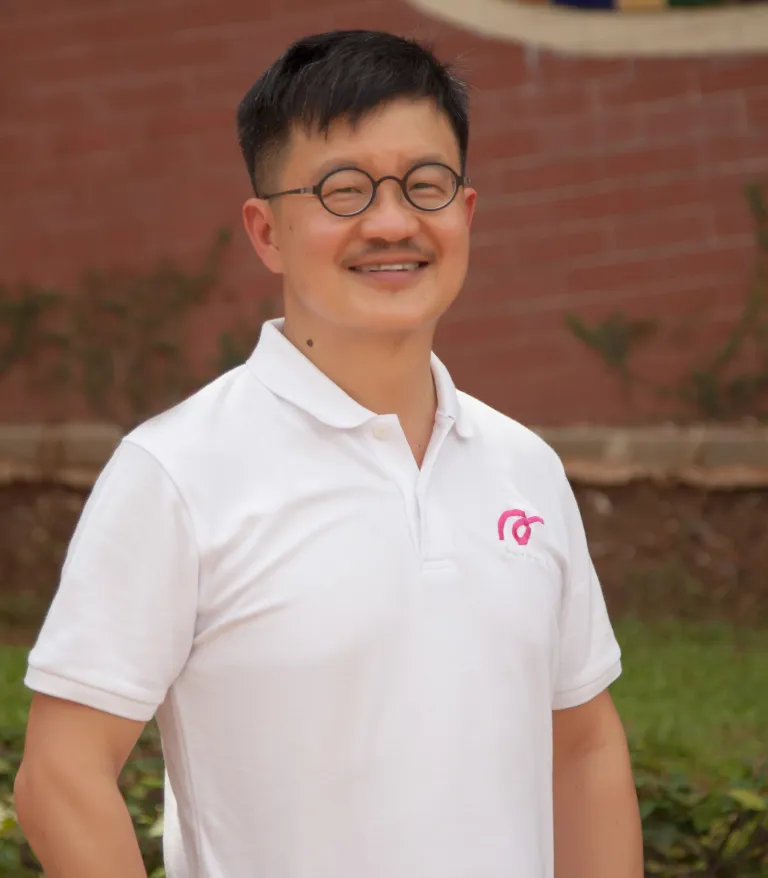
Four days of holiday break and every campus cafeteria was closed. It was Thanksgiving 1985, and Tandean Rustandy had $5 to his name.

He had nowhere to go for the holiday. CU Boulder’s dorms were still open, which meant he could relax over the long weekend, albeit alone, in his room at Libby Hall. So he took that $5, walked to a grocery store, bought a raw chicken and a bag of rice, and cooked four days of meals with a rice cooker in his dorm room.

He felt lucky. Tandean classTandean was an undergraduate business student from Indonesia and the first in his family to get a college education. His working-class parents, with only middle-school educations, helped pay for it by selling their house back in their village. He worked three jobs in Boulder—one of them washing pots and pans in Nichols Hall for $3.25 an hour—and only got haircuts twice a year. He borrowed money from his college roommate to pay his last tuition bill. But he felt lucky to have the American college experience, rooting for the Colorado Buffs football team and going to the popular college bar Tulagi with friends.

“One of the best times of my life is in Boulder. The best. The best,” Tandean says.

When he graduated from CU in 1987, only his mother attended ceremonies because his parents could afford just one plane ticket to the United States. It was at his mother’s urging, after all, that Tandean studied at CU in the first place.

“Education is everything,” she would remind him.

Now Tandean is the one reminding CU Boulder students that education unlocks possibilities.

As the founder and chief executive officer of one of the world’s most successful ceramic-tile manufacturing companies, Tandean supports the Leeds School of Business, both philanthropically and philosophically.

He has twice hosted groups of CU students in Jakarta through the Leeds School’s Global Initiatives program, where undergraduates learn about business and culture in a global marketplace while supporting the local community, a mission close to Tandean’s heart. He invests in the university to lead the charge in entrepreneurship education. He mentors students about giving their best, today in their academics and in the future as alumni.

“This school really means a lot to me. Who I am today is because of the very strong foundation I received at CU Boulder,” says Tandean, who was honored in 2014 with a Leeds School alumni service award. “I share with the CU students that the quality of this school depends on you. As student, as an alum, you need to create something.”

Campus
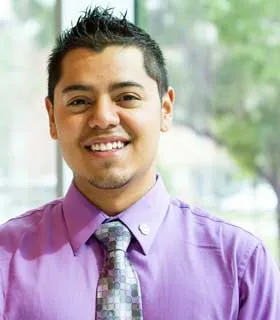
William Mundo
Content Section

When he graduated in May, William Mundo reached a milestone in his journey at the University of Colorado Denver.

It’s a journey that almost didn’t even start.

It’s good for him—and us—it did.

Before William devoted countless hours to his studies over four years and emerged as one of the university’s most well-known volunteers and respected student leaders, he and his mother had a pivotal conversation about whether he’d even attend college.  

“OK,” he recalls her saying. “You want to go to college. None of us have ever done it, but I’ll support you.”

But “it’s $10,000 a year,” he told her.

“We can’t pay that,” she said.

William insisted: “Mom, don’t worry.”

He had a plan.

William’s journey began modestly. Born in Los Angeles to parents who emigrated from Acapulco, Mexico, he and his family eventually moved to Leadville, high in the Colorado mountains. He remembers observing his father treating people in their community, so he assumed his father was a doctor.

“It wasn’t until I was much older that I figured out that my father didn’t get past sixth grade,” William says. “He had to drop out and help the family put food on the table since it was really difficult for my family in Mexico.”

Seeing his father care for his community inspired him: “I want to be a doctor. That really pushed me to pursue that career.”

At CU Denver, he studied public health and ethnic studies with an eye on medical schools. His goals include combating race-based health disparities and improving health care throughout the world, especially for impoverished communities. He’s also considering joining the Air Force with the hope to become a medical doctor in the military.

“I have a passion for serving others,” he says.

These paths wouldn’t have opened to him if he didn’t remain dedicated to his plan—the one he assured his mom would help him attend college.

“This doesn’t happen without scholarships,” William says. “They’ve made it possible for me to come to college and pursue my dream.”

CU Denver-based philanthropy like the Graham Family Scholarships and Alumni Association General Scholarships offered him assistance. So did the Latin American Educational Foundation and The White Rose Scholarship Foundation.

“They have really made an impact on my life because navigating the education system as a first-generation student is very difficult,” he says.

When others cared for him, he discovered the chance to care for others.

“It’s given me hope,” he says, “that there’s still people out there that really care about people like me and want us to do well.”

Campus